 Add to Chrome
 Add to Firefox
 Add to Edge
Every Step Evolves: Scaling Reinforcement Learning for Trillion-Scale Thinking Model
Oct 21, 2025
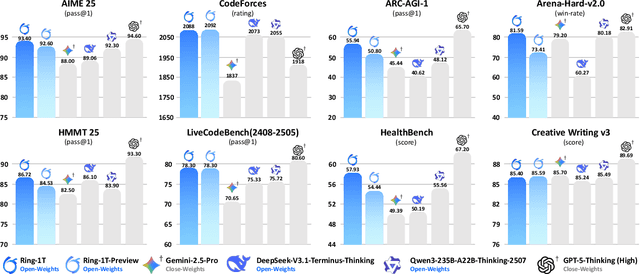
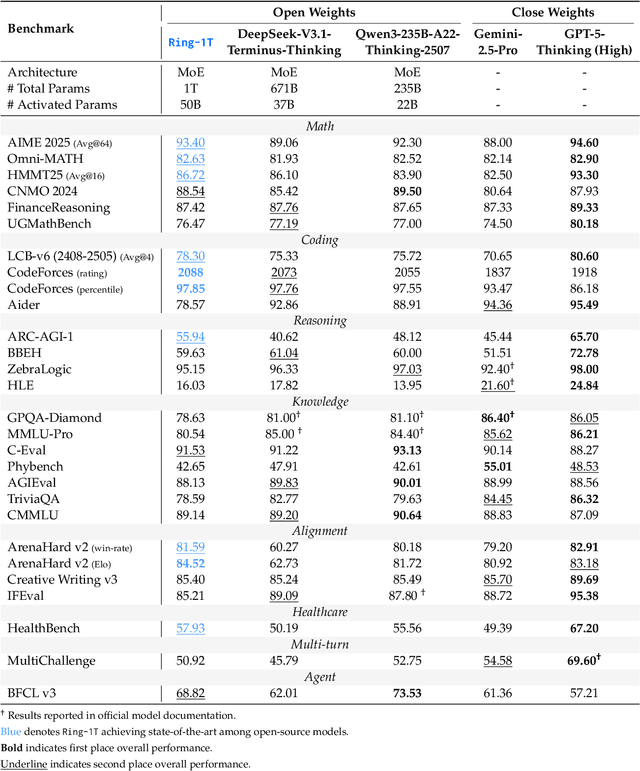
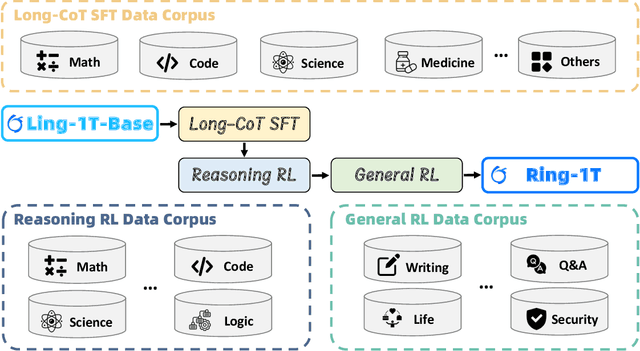
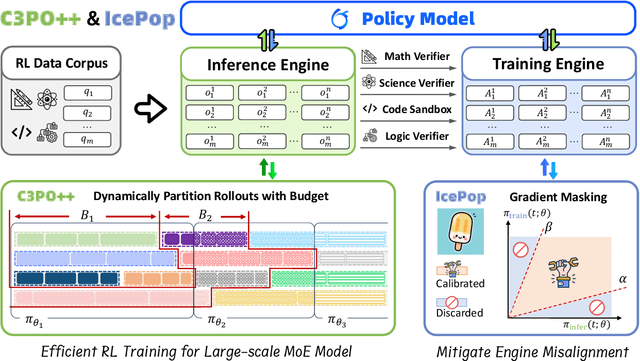
We present Ring-1T, the first open-source, state-of-the-art thinking model with a trillion-scale parameter. It features 1 trillion total parameters and activates approximately 50 billion per token. Training such models at a trillion-parameter scale introduces unprecedented challenges, including train-inference misalignment, inefficiencies in rollout processing, and bottlenecks in the RL system. To address these, we pioneer three interconnected innovations: (1) IcePop stabilizes RL training via token-level discrepancy masking and clipping, resolving instability from training-inference mismatches; (2) C3PO++ improves resource utilization for long rollouts under a token budget by dynamically partitioning them, thereby obtaining high time efficiency; and (3) ASystem, a high-performance RL framework designed to overcome the systemic bottlenecks that impede trillion-parameter model training. Ring-1T delivers breakthrough results across critical benchmarks: 93.4 on AIME-2025, 86.72 on HMMT-2025, 2088 on CodeForces, and 55.94 on ARC-AGI-v1. Notably, it attains a silver medal-level result on the IMO-2025, underscoring its exceptional reasoning capabilities. By releasing the complete 1T parameter MoE model to the community, we provide the research community with direct access to cutting-edge reasoning capabilities. This contribution marks a significant milestone in democratizing large-scale reasoning intelligence and establishes a new baseline for open-source model performance.

Anchor Free remote sensing detector based on solving discrete polar coordinate equation
Mar 25, 2023As the rapid development of depth learning, object detection in aviatic remote sensing images has become increasingly popular in recent years. Most of the current Anchor Free detectors based on key point detection sampling directly regression and classification features, with the design of object loss function based on the horizontal bounding box. It is more challenging for complex and diverse aviatic remote sensing object. In this paper, we propose an Anchor Free aviatic remote sensing object detector (BWP-Det) to detect rotating and multi-scale object. Specifically, we design a interactive double-branch(IDB) up-sampling network, in which one branch gradually up-sampling is used for the prediction of Heatmap, and the other branch is used for the regression of boundary box parameters. We improve a weighted multi-scale convolution (WmConv) in order to highlight the difference between foreground and background. We extracted Pixel level attention features from the middle layer to guide the two branches to pay attention to effective object information in the sampling process. Finally, referring to the calculation idea of horizontal IoU, we design a rotating IoU based on the split polar coordinate plane, namely JIoU, which is expressed as the intersection ratio following discretization of the inner ellipse of the rotating bounding box, to solve the correlation between angle and side length in the regression process of the rotating bounding box. Ultimately, BWP-Det, our experiments on DOTA, UCAS-AOD and NWPU VHR-10 datasets show, achieves advanced performance with simpler models and fewer regression parameters.